19 November 2016

Dinovember 2016, Days 18 & 19

Armoured Edmontonia and Dyoplosaurus pass each other amongst the ferns on
a steep embankment in what will one day be Canada's Dinosaur Provincial Park.
Name: Edmontonia rugosidens
Meaning: rough-toothed Edmontonian [the original material was found in what was then called the Edmonton Formation]
Time: Late Cretaceous, c. 76.5 million years ago
Place: Alberta
Size: about 5.8 metres (19 feet) long and 3 tonnes (3.3 tons) or more
Type of Dinosaur: nodosaurid ankylosaur (clubless armoured dinosaur)

Name: Dyoplosaurus acutosquameus 
Meaning: acute-scaled double-armoured reptile
Time: Late Cretaceous, c. 76.5 million years ago
Place: Alberta
Size: about 4-5 metres (13-16.4 feet) long, possibly larger
Type of Dinosaur: ankylosaurid ankylosaur (club-tailed armoured dinosaur)

A double dose of Dinovember, featuring a pair of armoured ankylosaurs from Canada's famous Dinosaur Park Formation. Edmontonia, on the left, is from the tail club-lacking lineage of ankylosaurs called nodosaurids. It had large shoulder spikes that would have made formidable offensive or defencive weapons. On the right is Dyoplosaurus, which was widely considered the same as the better-known Euoplocephalus until recently. It was one of the club-tailed ankylosaurids, but unlike Euoplocephalus, Dyoplosaurus had a fairly small, narrow tail club. Both nodosaurids and ankylosaurids would have relied on their tough armour and broad bodies to protect themselves from predatory tyrannosaurs.

17 November 2016

Dinovember 2016, Day 17

A big, arched nose and fun in the mud: Gryposaurus is my kind of dinosaur.
Name: Gryposaurus monumentensis
Meaning: [Grand Staircase-Escalante National] Monument hook-nosed reptile
Time: Late Cretaceous, c 76 million years ago
Place: Utah
Size: generally about 8-9 metres (26.2-29.5 feet) long and 3-4 tonnes (3.3-4.4 tons) or so, but larger material from Utah referred to this species suggests large individuals of at least 12 metres (39.4 feet) and probably 8-10 tonnes (8.8-11 tons)
Type of Dinosaur: kritosaurin saurolophine (Roman-nosed duckbill dinosaur)

Gryposaurus is a duckbill near and dear to my heart - we have very similar nose shapes. Additionally, while saurolophine duckbills are more often overshadowed by their hollow-crested lambeosaurine cousins, Gryposaurus had the big size and burly build to make it just as impressive as its more elaborately-adorned kin. These Gryposaurus are enjoying a mud wallow, something I believe many dinosaurs would have done just like many big animals today. The huge individual at the back represents the larger known material, while the smaller ones at the front still have a lot of growing to do; in most dinosaur communities, adolescent animals that were capable of breeding but still were far from 'full size' would have really dominated, as opposed to really big adult animals.

16 November 2016

Dinovember 2016, Day 16

A snake snack.
Name: Byronosaurus jaffei
Meaning: [museum supporter] Byron Jaffe's reptile
Time: Late Cretaceous, c 75 million years ago
Place: Mongolia
Size: around 1.4 metres (4.6 feet) long
Type of Dinosaur: troodontid paravian (very near-bird predatory dinosaur)

Byronosaurus was a troodontid, a group of dinosaurs with excellent hearing and vision. It lived in the desert and had a long, narrow snout with small teeth. It looks to me like it would be well adapted to snatching up small prey like snakes - which is just what this one has done.

15 November 2016

Dinovember 2016, Day 15

He's watching you.
Name: Herrerasaurus ischigualastensis
Meaning: [discoverer Victorino] Herrera's reptile from Ischigualasto [Formation]
Time: Late Triassic, c 231.4 million years ago
Place: Argentina
Size: about 3.5 metres (11.5 feet) long and 210 kilograms (463 pounds)
Type of Dinosaur: herrerasaurid theropod (primitive predatory dinosaur)

Herrerasaurus is one of the oldest dinosaurs known. Due to its early time and primitive characteristics have made its classification difficult. At various times, it has been considered a theropod, a primitive saurischian (lizard-hipped) dinosaur before the sauropodomorph-theropod split, a sauropodomorph (the lineage that would yield the giant long-necked plant-eaters), a dinosaur outside the saurischian-ornithischian split, or not even a dinosaur. Most recent studies suggest that it is in fact a theropod, and additional discoveries have revealed some similar sorts of dinosaurs.

In this drawing, a Herrerasaurus is stalking past a toppled tree, lurking under some cycad fronds. Mostly, an attempt to keep my Dinovember drawings from being too empty.

14 November 2016

Dinovember 2016, Day 14


Fancy frill.

Name: Regaliceratops peterhewsi
Meaning: [discoverer] Peter Hews's regal horned face
Time: Late Cretaceous, c 68 million years ago
Place: Alberta
Size: about 5 metres (16.4 feet) long and 1.5-2.5 tonnes (1.7-2.8 tons)
Type of Dinosaur: triceratopsin chasmosaurine (advanced three-horned 'long-frilled' horned dinosaur)

Named in 2015, Regaliceratops is a bit odd for being a very close cousin of the famous Triceratops. Instead of a long, relatively unadorned frill, a short nose horn, and long brow horns, Regaliceratops looks more like a member of the centrosaurine branch of horned dinosaurs, with a big nose horn and tiny brow horns, and a short frill that has large, rounded decorations around the edges. Perhaps Triceratops is part of a lineage that had some more weird members that await discovery.

My drawing of Regaliceratops is a based heavily on a Charles R Knight painting - perhaps my favourite dinosaur painting ever, actually - of a dubious genus of ceratopsian called Agathaumas. Agathaumas remains are almost certainly attributable to Triceratops as well as other dinosaurs, but Knight's highly speculative restoration of this creature is incredibly life-like. The large plated scales, the thick rhinoceros-like neck folds, and the overall presentation of the dinosaur make it seem as though the artist painted it at an easel set up in a Late Cretaceous meadow. Although the restoration was largely speculation, what we know now about horned dinosaur skin makes it seem pretty reasonable. I was struck by the surprising resemblance of the real Regaliceratops when it was announced to Knight's semi-fictitious Agathaumas, and wanted to pay homage to one of the great palaeoart renderings in this Dinovember entry.

13 November 2016

Dinovember 2016, Day 13

Sauropods may have had noisy noses. 
Name: Daxiatitan binglingi
Meaning: titan of the Daxia [branch of the Yellow River] from Bingling Temple [famous site near where it was found]
Time: Early Cretaceous, c 122.6 million years ago
Place: northwestern China
Size: about 23 metres (75.5 feet) long and 20-25 tonnes (22-27.6 tons)
Type of Dinosaur: euhelopodid macronarian (very long-necked big nosed plant-eating dinosaur)

Despite initial claims of extreme size, Daxiatitan does not appear to be one of the largest dinosaurs of all time, attaining a size that, while certainly respectable, is not all that giant among the sauropods. It belonged to a derived group of sauropod dinosaurs with extremely long necks and long forelimbs that is so far only known from Asia.

In this picture, I imagined a male Daxiatitan, at back, courting a female by making a bellowing call and inflating colourful flaps of skin around his nose and along his neck. Both sexes have similar patterns though.

12 November 2016

Dinovember 2016, Day 12

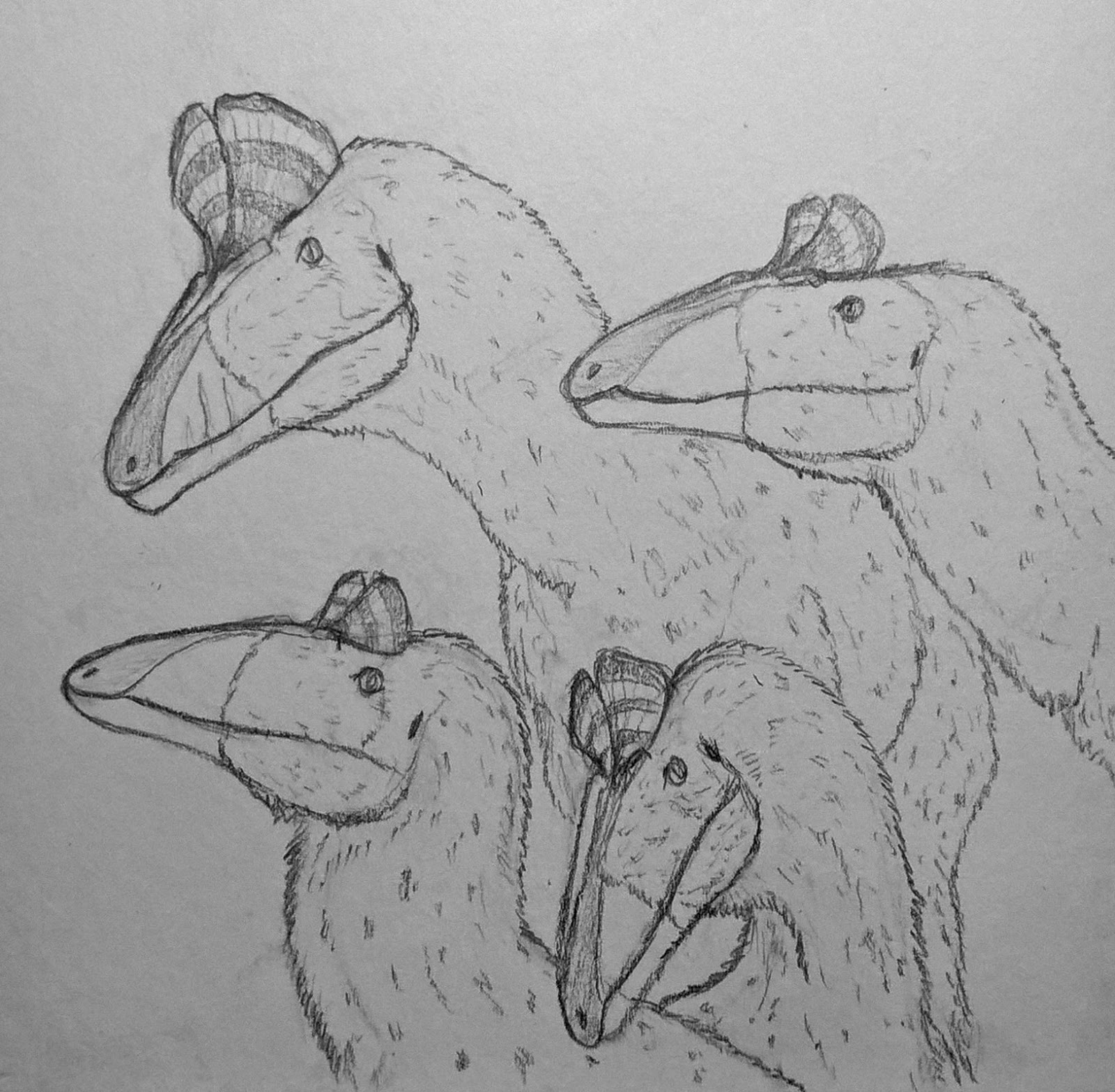
I guess you can pick which one is Elvis and which ones are Jordanaires. 
Name: Cryolophosaurus ellioti
Meaning: [geologist David] Elliot's frozen crested reptile
Time: Early Jurassic, c 190 million years ago
Place: Antarctica
Size: about 6.5 metres (21.3 feet) long, but the known specimen is a subadult
Type of Dinosaur: uncertain, but probably a tetanuran theropod (advanced stiff-tailed predatory dinosaur)

Antarctica probably teemed with dinosaurs over the Mesozoic Era, but its frigid climate makes palaeontological work there very difficult. Cryolophosaurus is one of only a handful of dinosaurs to be excavated from the continent, and the first Antarctic dinosaur to be named and described. A popular nickname for this predator is 'Elvisaurus,' in reference to the tall, forward-swept pompadour-like crest on top of the head. This structure was too breakable for any physical combat but would've made a brilliant visual signal.

Here I've illustrated a fluffy family of Cryolophosaurus - with slightly different crest sizes and shapes to indicate differences between sex, age, and individual condition. The feathery-fuzz coatings are speculative, but Antarctica would've been quite chilly, even during the mostly-steamy Early Jurassic, so these dinosaurs probably would have benefited from the added insulation.