Showing posts with label theropods. Show all posts

30 November 2016

Dinovember 2016, Day 30

In loving memory of Campephilus principalis, Mid-Pleistocene - AD 1944. 
Name: Campephilus principalis
Meaning: chief grub-lover
Time: Holocene, c 70 years ago
Place: southeastern United States
Size: 53 centimetres (21 inches) long, wingspan over 76 centimetres (30 inches)
Type of Dinosaur: picid piciform (woodpecker)

Hey, nobody said this was Non-Avian Dinovember! And this bird is, sadly, an extinct dinosaur just like the preceding 29 entries. Campephilus principalis, or as it is better known, the ivory-billed woodpecker, was one of the biggest woodpecker species, inhabiting the extensive swamp forests of the Deep South until the 1940s. These impressive birds needed large swathes of land to sustain themselves, and excessive logging in the late 19th and early 20th centuries destroyed their habitats, leading to the woodpeckers becoming vanishingly rare by around the '30s, and the last confirmed sighting of an ivory-billed woodpecker in the United States was in 1944. Sporadic sightings have cropped up since then, most notably around 2005 when there was rather great furore in the ornithological world about the 'rediscovery' of the ivory-bill, but any hard evidence remains to be seen. It's more likely that the magnificent ivory-billed woodpecker really has vanished into extinction, like so many other dinosaurs before it.

28 November 2016

Dinovember 2016, Days 24-28

Wow, looks like I got behind again. Here's five dinosaurs in one go! Let's see...

Shuvuuia: what's so great about a pair of arms?
Name: Shuvuuia deserti
Meaning: desert bird
Time: Late Cretaceous, c 75 million years ago
Place: Mongolia
Size: about 60 centimetres (23.6 inches) long
Type of Dinosaur: parvicursorine alvarezsaurid (single-clawed bird-like dinosaur)

Shuvuuia is an odd little dinosaur, part of a group initially thought to be flightless birds. These fuzzy creatures had long, narrow snouts and tiny teeth and a single claw on their extremely shortened arms. A common idea is that they would have used their claws to open insect nests and then snarfed them up; sort of dinosaurian anteaters. Here, one Shuvuuia is preening another.

Deinocheirus: why stop at just a pair of arms?
Name: Deinocheirus mirificus
Meaning: peculiar terrible hand
Time: Late Cretaceous, c 72 million years ago
Place: Mongolia
Size: about 11 metres (36 feet) long and 6.3 tonnes (6.9 tons)
Type of Dinosaur: deinocheirid ornithomimosaur (weirdo ostrich dinosaur)

For many years, Deinocheirus was one of the great mysteries of palaeontology. A pair of powerfully-clawed forelimbs, 2.4 metres (7.9 feet) long, and nothing else. What were they from? Was it a carnosaur far larger than any other, opening up sauropods like tins of sardines? Was it one of those odd ground sloth-like therizinosaurs? The arms are actually very much like the ostrich dinosaurs' - perhaps it's one of those?

Turns out that the last one was right, but Deinocheirus wasn't just a big and bulky Struthiomimus, not at all. In 2014, complete skeletons of this mysterious monster finally were revealed to the world, and Deinocheirus was more bizarre than anyone imagined. Huge and bulky, with a towering hump on its back, a spoonbill, and a very deep lower jaw. Stomach contents preserve fish and gastroliths, showing an omnivorous diet. Wild, wild stuff.

A fine feathery face on a small forest herbivore.
Name: Agilisaurus louderbacki
Meaning: [geologist George] Louderback's agile reptile
Time: Middle Jurassic, c 168 million years ago
Place: southwest China
Size: about 1.2 metres (3.9 feet) long, but the known specimen may be a juvenile
Type of Dinosaur: neornithischian genasaur (primitive-advanced beaked dinosaur)

Agilisaurus louderbacki, like many dinosaurs, is only known from a single specimen. Fortunately, though, it's a very good one with virtually all the bones represented. It's a small beaked herbivore, and remains from Russia show that at least some of these dinosaurs had feathery coverings on their bodies, so I've restored Agilisaurus with such integument here.

Desert sky, dream beneath a desert sky, rivers run but soon run dry...
Name: Alamosaurus sanjuanensis
Meaning: San Juan [County, New Mexico, where it was discovered] Ojo Alamo [Formation] reptile
Time: Late Cretaceous, c 66 million years ago
Place: Texas, New Mexico, Utah; probably Wyoming and Mexico as well
Size: complete specimens about 20 metres long (66 feet) and 16 tonnes (17.6 tons) are subadult; fragmentary remains generally considered to be from Alamosaurus suggest sizes of 30 metres (98 feet) and more than 50 tonnes (55 tons)
Type of Dinosaur: opisthocoelocaudiine saltasaurid (column-handed advanced armoured long-necked dinosaur)

The only sauropod currently known from Late Cretaceous North America, Alamosaurus is undoubtedly one of the best animals ever. It lived right at the end of the Age of Reptiles, alongside T. rex, and grew to be one of the biggest land animals. More and more remains of this giant seem to be cropping up in recent years, and hopefully more will reveal what their growth and lifestyle was like.

There's something FISHY about little Liaoningosaurus...
Name: Liaoningosaurus paradoxus
Meaning: paradoxical Liaoning [Province, where it was discovered] reptile
Time: Early Cretaceous, c 122 million years ago
Place: northeast China
Size: 34 centimetres (13.4 inches) long; whether the described specimen is an adult or not is debated
Type of Dinosaur: ankylosaurid ankylosaur (armoured dinosaur)

Recently, Liaoningosaurus has gotten some attention as a new study suggests it was semiaquatic and fed on fish, as evidenced by fish remains in its stomach, and that the described specimen (apparently, many, many other ones are known) is actually a grown adult! These claims have understandably drawn criticism, and apparently the paper does not do a terrific job of making its case. However, I don't think we should readily dismiss these claims - it honestly seems like a very plausible niche for an ankylosaur to occupy, and as more fossils are described they'll help us understand just what the natural history of this odd little armoured dinosaur was...

23 November 2016

Dinovember 2016, Day 22

Unhappy that the tyrannosaurs were hogging the spotlight for short arms,
Gualicho convergently evolved a set of nubby didactyl grabbers of its own.
Name: Gualicho shinyae
Meaning: [Field Museum fossil preparator Akiko] Shinya's gualichu [a South American folkloric demon]
Time: Late Cretaceous, c 93 million years ago
Place: Patagonia
Size: uncertain, probably about 6-7 metres (19.7-23 feet) long
Type of Dinosaur: neovenatorid carcharodontosaur (oddball large carnivorous dinosaur)

Gualicho was named and described earlier this year. It's a rather bizarre South American predator known from only a partial skeleton. Its most striking feature is its arms, which have only two fingers and are very reduced in size, much like a tyrannosaur. In fact, Gualicho and its relatives, the Neovenatoridae, are of rather uncertain placement. Various features of their anatomy are reminiscent of the more birdlike tyrannosaurs, rather than the carcharodontosaurs they were initially thought to be related to. But further studies have suggested that the tyrannosaur-like features are products of that old rascal convergent evolution, and their underlying anatomy really does support a carcharodontosaur affinity. For now, the best answer is probably that neovenatorids are indeed carcharodontosaurs that occasionally developed tyrannosaur-like features, but several neovenatorids have been found recently and more work on these bizarre theropods will hopefully make their relationships more clear.

I still gave Gualicho a coat of simple feathers, as I think our best evidence is that (at least partial) feathery coverings are the original condition for dinosaurs, and that some groups lost these coverings. Even within some groups, I imagine there's probably variety in body coverings - even amongst living animals, lots of closely related species vary quite a bit in their hairiness/scales/whatever. The head and neck are necked and covered with caruncled skin, and the nubby arms themselves are bare too, and partially hidden in the shaggy feathers.

16 November 2016

Dinovember 2016, Day 16

A snake snack.
Name: Byronosaurus jaffei
Meaning: [museum supporter] Byron Jaffe's reptile
Time: Late Cretaceous, c 75 million years ago
Place: Mongolia
Size: around 1.4 metres (4.6 feet) long
Type of Dinosaur: troodontid paravian (very near-bird predatory dinosaur)

Byronosaurus was a troodontid, a group of dinosaurs with excellent hearing and vision. It lived in the desert and had a long, narrow snout with small teeth. It looks to me like it would be well adapted to snatching up small prey like snakes - which is just what this one has done.

15 November 2016

Dinovember 2016, Day 15

He's watching you.
Name: Herrerasaurus ischigualastensis
Meaning: [discoverer Victorino] Herrera's reptile from Ischigualasto [Formation]
Time: Late Triassic, c 231.4 million years ago
Place: Argentina
Size: about 3.5 metres (11.5 feet) long and 210 kilograms (463 pounds)
Type of Dinosaur: herrerasaurid theropod (primitive predatory dinosaur)

Herrerasaurus is one of the oldest dinosaurs known. Due to its early time and primitive characteristics have made its classification difficult. At various times, it has been considered a theropod, a primitive saurischian (lizard-hipped) dinosaur before the sauropodomorph-theropod split, a sauropodomorph (the lineage that would yield the giant long-necked plant-eaters), a dinosaur outside the saurischian-ornithischian split, or not even a dinosaur. Most recent studies suggest that it is in fact a theropod, and additional discoveries have revealed some similar sorts of dinosaurs.

In this drawing, a Herrerasaurus is stalking past a toppled tree, lurking under some cycad fronds. Mostly, an attempt to keep my Dinovember drawings from being too empty.

12 November 2016

Dinovember 2016, Day 12

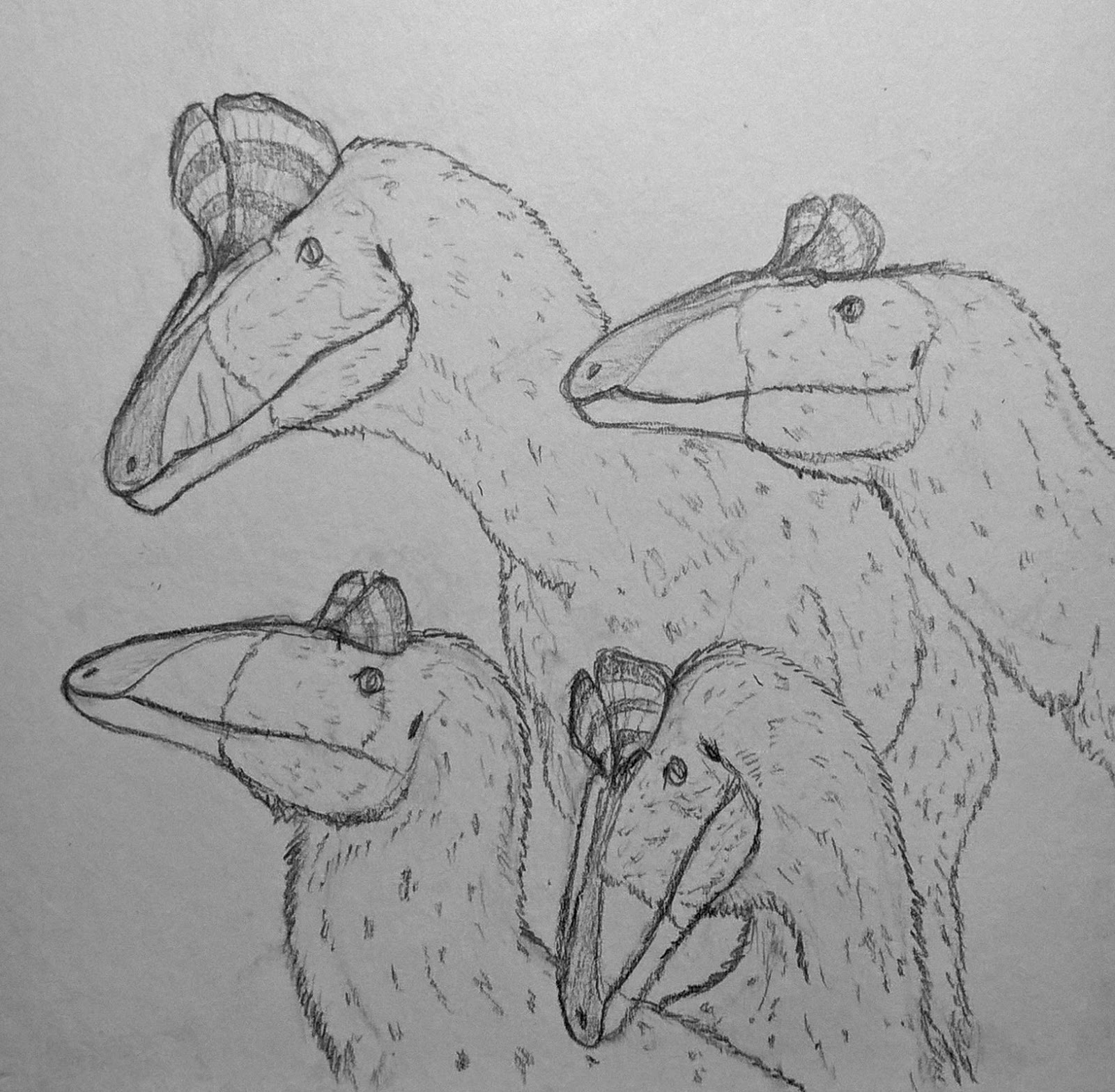
I guess you can pick which one is Elvis and which ones are Jordanaires. 
Name: Cryolophosaurus ellioti
Meaning: [geologist David] Elliot's frozen crested reptile
Time: Early Jurassic, c 190 million years ago
Place: Antarctica
Size: about 6.5 metres (21.3 feet) long, but the known specimen is a subadult
Type of Dinosaur: uncertain, but probably a tetanuran theropod (advanced stiff-tailed predatory dinosaur)

Antarctica probably teemed with dinosaurs over the Mesozoic Era, but its frigid climate makes palaeontological work there very difficult. Cryolophosaurus is one of only a handful of dinosaurs to be excavated from the continent, and the first Antarctic dinosaur to be named and described. A popular nickname for this predator is 'Elvisaurus,' in reference to the tall, forward-swept pompadour-like crest on top of the head. This structure was too breakable for any physical combat but would've made a brilliant visual signal.

Here I've illustrated a fluffy family of Cryolophosaurus - with slightly different crest sizes and shapes to indicate differences between sex, age, and individual condition. The feathery-fuzz coatings are speculative, but Antarctica would've been quite chilly, even during the mostly-steamy Early Jurassic, so these dinosaurs probably would have benefited from the added insulation.

Dinovember 2016, Day 11

Sorry, got a day behind in posting. I'll post two in a row here...

The Terror of the South, looking very regal.
Name: Acrocanthosaurus atokensis
Meaning: high-spined reptile from Atoka [County, Oklahoma]
Time: Early Cretaceous, c 112 million years ago
Place: Texas, Oklahoma, and probably elsewhere in the US
Size: up to 11.5 metres (37.7) long, probably between 5.7-7.3 tonnes (6.3-8 tonnes)
Type of Dinosaur: carcharodontosaurid allosauroid ('landshark' predatory dinosaur)

You may remember seeing photos of this dinosaur's skeleton here on the blog not too long ago. I decided to do a restoration of it, as it's among my favourite dinosaurs. Acrocanthosaurus must have been a truly incredible animal to behold in life; its high spines would have given it a deep body profile, and its large, sleekly sloped head would've made an impressive display structure too. I didn't want to make it too adorned, as it is essentially an active pursuit predator (albeit a rather slow one) that would have been actively trailing and attacking huge sauropods, as shown by footprint evidence.

07 November 2016

Dinovember 2016, Day 7

Ornitholestes doesn't mind you noticing his baldness. 
Name: Ornitholestes hermanni
Meaning: [AMNH fossil preparator Adam] Hermann's bird robber
Time: Late Jurassic, c 154 million years ago
Place: Wyoming
Size: about 2 metres (6.6 feet) long and 15 kilograms (33 pounds)
Type of Dinosaur: tyrannoraptoran coelurosaur (birdlike predatory dinosaur)

Despite being one of the better-known coelurosaurs and small dinosaurs of the Jurassic Period, Ornitholestes is only known from one specimen, unearthed in 1900 at Bone Cabin Quarry in Wyoming - the site where the Diplodocus limbs and Dryosaurus skeleton on display at the Beneski Museum are from. In fact, Amherst College's very own bone bloodhound, Frederic Brewster Loomis, was a member of the team that excavated the single skeleton during his days working for the American Museum of Natural History.

The relationships of Ornitholestes have long been contentious, but it's definitely a bird-like coelurosaur, and thus would've had some sort of feathery covering. I've given this one a naked, bare-skinned head, both a nod to Gregory S Paul's 1988 Predatory Dinosaurs of the World restoration and just a look that I like to use a lot. The rest of the body is covered in loose feathers, with longer ones forming a sort of ruff at the base of the neck. And no, it doesn't have a little crest on its nose - that common element of Ornitholestes reconstructions was based on crushing of the skull during fossilisation.

04 November 2016

Dinovember 2016, Day 4

Leaping Laelaps, 2016 edition.
Name: Dryptosaurus aquilunguis
Meaning: eagle-clawed tearing reptile
Time: Late Cretaceous, c 67 million years ago
Place: New Jersey, possibly North Carolina and elsewhere in the Eastern US
Size: uncertain, but probably around 7.5 metres (25 feet) long
Type of Dinosaur: mysterious tyrannosauroid (tyrant dinosaur) - perhaps an alioramin tyrannosaurine (slender-snouted advanced tyrant dinosaur)

Dryptosaurus - or as it was called at the time, Laelaps, a wonderful name from a mythological hound that was sadly found to be preoccupied by a mite - was one of the first nonavian theropod dinosaurs known to science. In 1896, Charles R Knight, maybe the greatest palaeoartist of them all, painted an iconic image called Leaping Laelaps in which a pair of these animals duke it out - it was one of the first images to portray dinosaurs as the dynamic, active creatures they truly were rather than as dull sluggards, and this painting remains breathtakingly beautiful and exciting even today.

Of course, knowledge of dinosaurs has progressed a lot since 1896. I wanted to revisit Leaping Laelaps and try my hand at restoring it now. Dryptosaurus remains a painfully mysterious dinosaur but evidence points to it being some sort of tyrannosauroid, and an analysis from early this year suggests it may be an alioramin - part of a group of tyrants so far exclusive to Mongolia and China, and known for their slender build and long, narrow skulls with small hornlets along the snout. Not only would Dryptosaurus be geographically unusual if it is an alioramin, what's known of its anatomy is odd too - it has very large, well-developed hand claws, whereas most advanced tyrants were reducing their arms significantly. Certainly an odd duck, Dryptosaurus, and I don't think we can be confident of much until we find more fossils of it - but I've restored it here as a North American alioramin with some serious fingers, while trying to keep the poses faithful to the Knightian original.

There's lots more to say about Dryptosaurus and the dinosaurs of Eastern North America, but that's for another time.

02 November 2016

Dinovember 2016, Day 2

Don't let the nubby arms fool you, abelisaurs are all business.
Name: Pycnonemosaurus nevesi
Meaning: Neves's thick forest reptile [after the Brazilian state of Mato Grosso, 'thick forest', where it was found]
Time: Late Cretaceous, c 70 million years ago
Place: Southwest Brazil
Size: about 8.6-9.1 metres (28-30 feet) long
Type of Dinosaur: brachyrostran abelisaurid (blunt-faced, stump-armed predatory dinosaur)

The abelisaurs were one of the dominant group of predators on the southern continents during the Cretaceous Period. Many types of abelisaurs are known, mainly from only partial remains, so estimating the body size of these animals has been contentious. A study from this year used methods consistent across all abelisaurs to estimate size, and the results found that Pycnonemosaurus has claimed the crown as the biggest of these southern killers yet known.

Abelisaurs have famously stumpy, practically vestigial arms - that could be rotated totally at the shoulder, like our own arms. It seems that these reduced limbs could have functioned as display devices, which is why I applied a bold tissue fan to the arm-nubs of the king of the abelisaurs in the portrait above.